Police find cannabis grow houses through a combination of tips from the public, physical and behavioral observation, utility analysis, and forensic checks. The investigation typically moves from initial suspicion to evidence gathering and then to a lawful search under warrant. Understanding how this works is genuinely useful whether you're worried about a neighbor's setup, trying to understand your own compliance risks, or simply curious about how enforcement operates in practice.
How Do Police Investigate Grow Houses and Grow Rooms

Marcus Whitley
11 Apr 2026
UK vs. General Police Approaches: What's Different, What's the Same
In England and Wales, cannabis cultivation investigation is formally structured around legislation like the Police and Criminal Evidence Act 1984 (PACE) and its Code B, which set strict rules about how searches are authorized and carried out. The National Police Chiefs' Council (NPCC) has explicitly described disrupting cannabis cultivation at the source as a key priority, connecting it to wider concerns about organized crime, human trafficking, and violence. That framing matters: police aren't just looking at individual plants, they're looking at networks.
In the United States and other jurisdictions, the legal framework is different but the investigative logic is similar. Officers build reasonable suspicion first, then escalate to formal evidence gathering, and finally seek a warrant before any lawful entry. The Fourth Amendment in the US and PACE in England/Wales both exist to prevent arbitrary searches, which means investigators have to follow a documented trail from tip to warrant. The methods used to detect a grow house are largely the same across countries; it's the legal scaffolding around those methods that varies.
How Police First Detect a Grow House
Tips and Intelligence Reports
The single most common starting point is a tip. Neighbors, landlords, utility workers, delivery drivers, and even anonymous callers report suspicious activity more often than any other detection method triggers an investigation. A tip doesn't immediately justify a search, but it does open a file and prompt officers to look harder at a property. If you've ever wondered what the signs your neighbor has a grow house actually look like from a police perspective, this is the answer: those same signs are exactly what informants describe when they call in a report.
Structured intelligence gathering also plays a role. Police analysts look at complaint histories for a property, prior contact records, and patterns across neighborhoods. A single complaint might be low priority; a pattern of complaints from multiple sources about the same address moves it up the list quickly.
Observation of Physical and Behavioral Signs
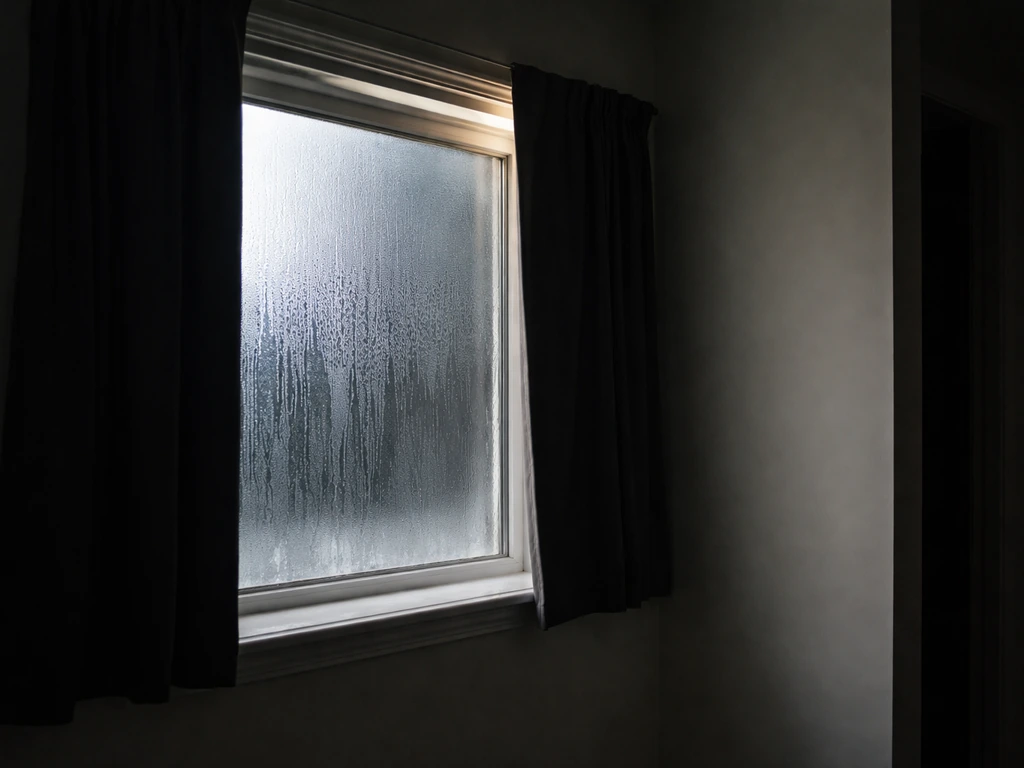
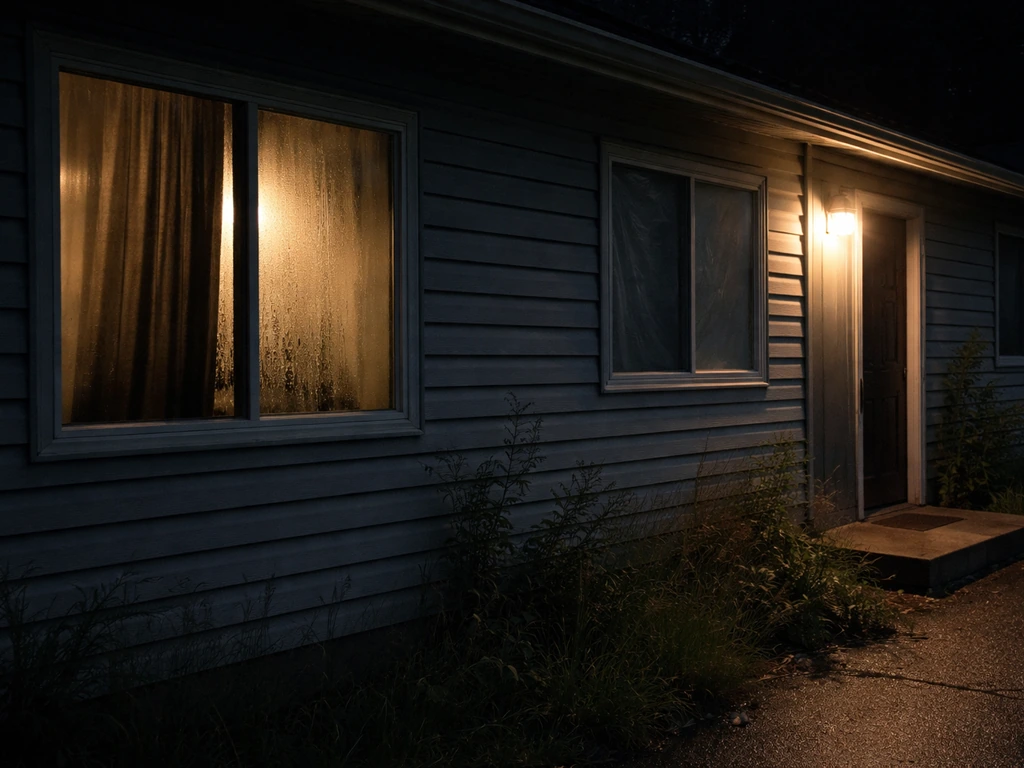
Officers and analysts are trained to recognize a cluster of telltale patterns. Blacked-out or permanently covered windows, unusual condensation on glass, bright light leaking at odd hours, and consistent unusual odor are all noted. According to a U.S. DOJ/NDIC publication on domestic cannabis cultivation, concealment and countersurveillance measures, such as camouflage, can be used in certain contexts to reduce detection during suppression efforts blank" rel="noopener noreferrer">Blacked-out or permanently covered windows. Heavy foot traffic at irregular times, frequent deliveries of growing supplies, and visible modifications to a property's ventilation (like new ducting or fans) also raise flags. Knowing how to spot a grow operation from the outside is essentially the same checklist police run through during initial observation.
Utility irregularities are particularly telling. Cannabis cultivation under artificial lighting draws significant power, often in amounts that stand out against baseline consumption for a property of a given size. Water usage can also spike. These anomalies are cross-referenced against billing records and meter data as part of the initial assessment.
Surveillance and Evidence Gathering Before a Warrant
Once initial suspicion is established, investigators move into a more structured evidence-gathering phase. This can include stationary surveillance of a property to document comings and goings, photography or video of observable activity from public spaces, and interviews with neighbors or known contacts. None of this requires a warrant because it doesn't involve entering the property.
In England and Wales, the College of Policing's Drug Crimes Evidence Briefing provides the evidential foundation that shapes how officers approach drug investigations, including what documentation they need before escalating. The standard for escalation is reasonable suspicion backed by articulable facts, not just a hunch. Officers have to be able to record and justify each step of the process, particularly once they start moving toward a warrant application.
Surveillance at this stage is also about identifying who is connected to the property. If police suspect organized cultivation linked to wider criminal activity, the investigation may expand significantly before any search takes place, building a picture of the supply chain rather than acting immediately on a single address.
Forensic Methods and Supporting Checks
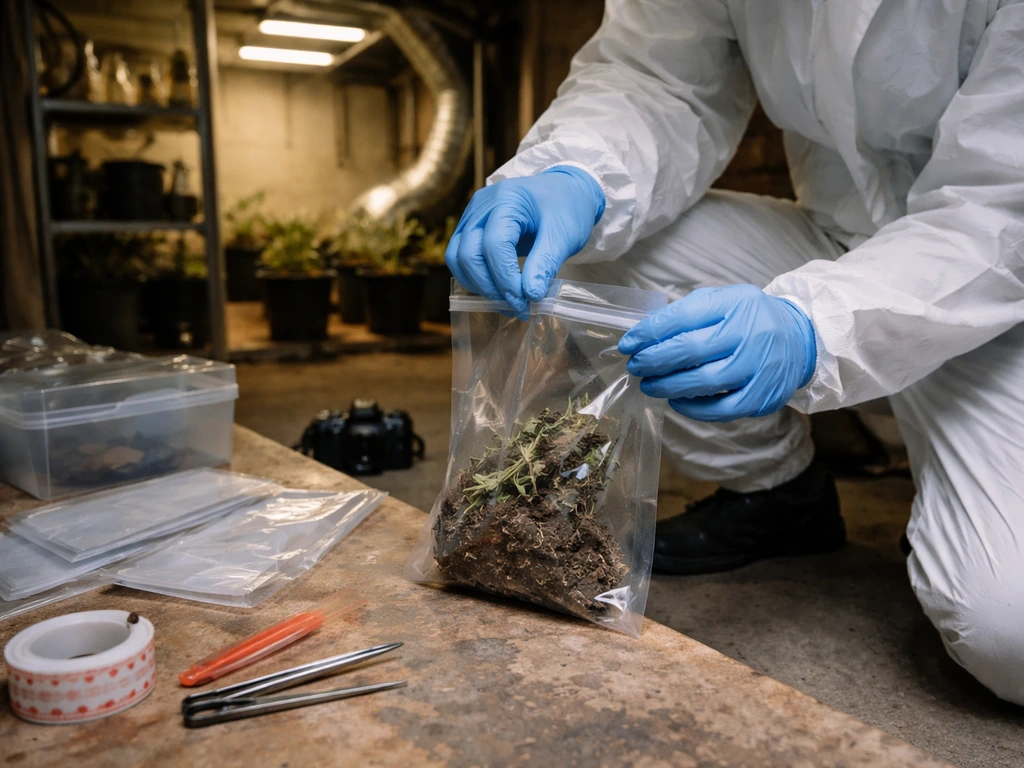
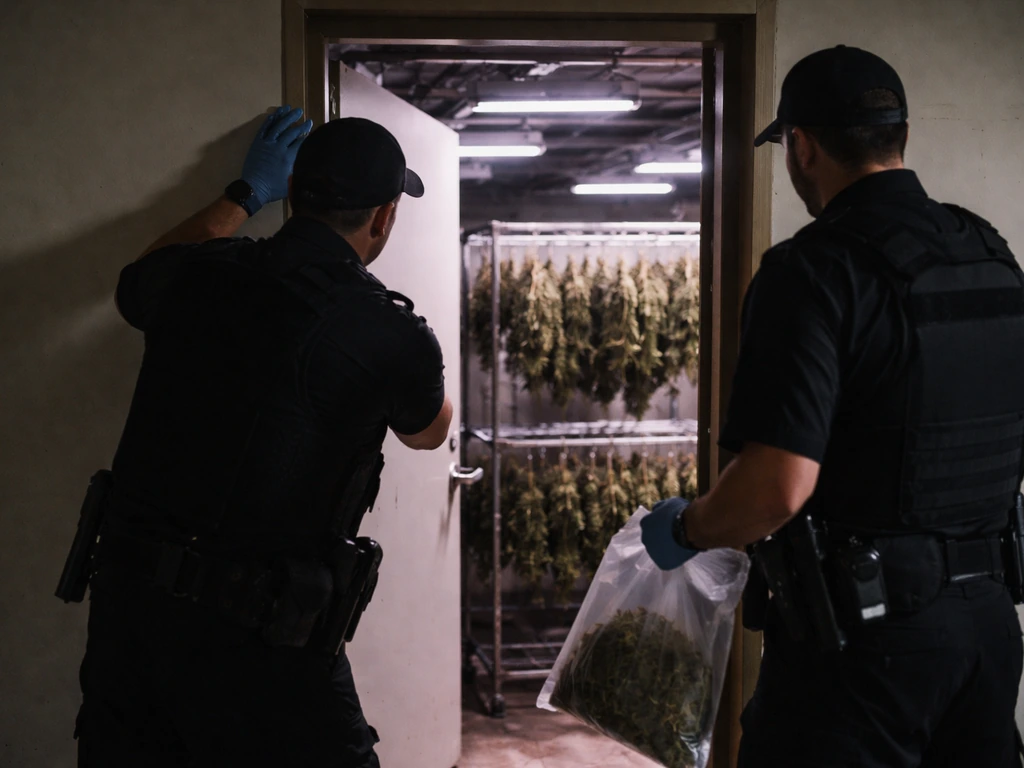
Once police have entered a premises lawfully, forensic work begins. In obvious cases, this is relatively straightforward. The Crown Prosecution Service notes Home Office guidance confirming that formal laboratory analysis of suspected cannabis is not required in cases likely to be handled in a magistrates' court, provided a trained officer can identify the substance by its physical appearance, texture, and smell, and identification isn't disputed. This is also reflected in Home Office Circular 015/2012. In practice, a seasoned officer walking into a grow room with mature plants can provide the identification evidence needed for prosecution without sending samples to a lab.
For more complex cases involving large-scale cultivation, suspected trafficking, or organized crime connections, forensic analysis goes much further. DNA profiling of plant material, fingerprint analysis on equipment, financial investigation of utility accounts and property records, and digital evidence from phones or computers all form part of the evidentiary picture. The goal is to build a case that goes beyond the plants themselves.
Utility records play a supporting role even after entry. Electricity and water consumption data obtained through formal requests from providers can corroborate what officers find inside, helping establish how long the operation has been running and at what scale.
Search Warrants, Legal Boundaries, and What 'Finding' Actually Means
A lawful search of a private property in England and Wales requires a warrant issued under PACE, and that warrant must be executed within three calendar months of the date it is issued. The College of Policing is explicit about this: officers must follow both the terms of the warrant and the requirements of PACE and Code B, and they must record the search, including an inventory of anything seized.
Code B also limits the scope of what can be searched. If a warrant names specific premises, officers cannot extend that search to other addresses controlled by the same person without separate written authority from an inspector who is not involved in the investigation. This matters practically: evidence obtained from a search that doesn't follow these rules can be challenged in court, and the CPS is clear that failure to observe PACE and Code B requirements can make evidence open to question.
The standard throughout the process is reasonable suspicion progressing to a realistic prospect of conviction. Police don't need certainty to start an investigation, but they do need documented, articulable grounds at every escalation step. 'Finding' a grow house in the investigative sense means building enough of a record to support a warrant, execute a lawful search, and then present evidence that meets the prosecution threshold.
A Quick Comparison: UK vs. US Investigation Framework
| Element | England and Wales (PACE) | United States (4th Amendment) |
|---|---|---|
| Legal basis for search | Warrant under PACE, issued by magistrate | Warrant based on probable cause, issued by judge or magistrate |
| Warrant time limit | Must be executed within 3 calendar months | Varies by jurisdiction, typically reasonable time |
| Scope restriction | Cannot search premises not named in warrant without written inspector authority | Search limited to areas and items specified in warrant |
| Cannabis ID without lab | Allowed in magistrates' court cases where officer identifies by sight/smell and not disputed | Officer testimony often accepted; lab analysis strengthens complex cases |
| Evidence challenge risk | Evidence challengeable if PACE/Code B not followed | Evidence excludable under exclusionary rule if 4th Amendment violated |
| Escalation standard | Reasonable suspicion, then realistic prospect of conviction | Reasonable suspicion, then probable cause |
What You Should Do Next, Depending on Why You're Reading This
If You Want to Grow Legally
The best protection against any of the above is operating inside the law from day one. That means understanding the licensing and plant-count rules in your specific jurisdiction before you grow a single plant. Start by checking what grow area you're in so you can identify the exact regulatory framework that applies to you, because rules vary significantly between states, counties, and even municipalities. Once you know your jurisdiction, you can look up license types, application requirements, and plant limits that apply to your situation.
Licensed, compliant cultivation eliminates virtually all of the risk factors that trigger investigations in the first place. If your utility usage is normal for a licensed operation, your setup is documented, and your licensing is current, the investigative triggers described above simply don't apply to you in the same way.
If You're Concerned About a Neighbor or Nearby Property
If you're worried about safety or legal exposure from a nearby grow operation, it's worth understanding whether it's safe to live next to a grow house and what the real risks are. Unlicensed operations can pose genuine hazards, from electrical overloads to associated criminal activity, separate from any plant-related concerns.
If you decide to report what you've observed, the process for doing so varies by location. For example, reporting a grow house in California involves specific local and state channels, and knowing the right route makes your report more likely to be acted on. In general, reports go to local law enforcement non-emergency lines, code enforcement agencies, or anonymous tip lines like Crimestoppers in the UK.
The Core Takeaway
Police investigations follow a predictable arc: tip or observation, documented suspicion, surveillance, warrant, search, and forensic evidence. At every stage, legal requirements constrain what officers can do and how they can use what they find. The most effective way to stay outside that process entirely is to grow within the rules your jurisdiction sets, which starts with knowing what those rules actually are.
FAQ
Can police investigate a grow house without entering the property?
Yes. In England and Wales, officers can observe from public places, review records they already lawfully hold, and interview people they have a lawful basis to speak with. What changes is entry, because that generally pushes the investigation into “warrant or other specific authority” territory.
If someone calls in a tip, does that automatically lead to a raid?
A tip usually creates a tasking or intelligence file, it does not automatically translate into a warrant. Investigators still need articulable facts to “connect the dots,” often by cross-checking other sources, consistency of complaints, and patterns in behavior or utilities.
What evidence do police need to justify escalating from suspicion to a warrant?
They generally document what they can lawfully see, including the basis for why each feature matters (time of day, visibility from a public vantage point, repeated observations). Random guesses or generalized suspicion are risky because each escalation step must be justifyable for a warrant.
Can normal household activity look like a grow operation?
Yes, the same observable pattern can produce different outcomes. For example, unusually high power draw could be consistent with many legal activities, so police typically corroborate with multiple indicators (location-specific consumption history, delivery patterns, ventilation modifications) rather than treating one anomaly as conclusive.
If police search one unit, can they also search other rooms or addresses tied to the same person?
There are practical limits. Police usually cannot expand a warrant to other addresses controlled by the same person unless they have separate written authority from the required decision-maker. So evidence from a “nearby unit” or “back room” search done without that authority can be challenged.
How long do police have to execute a warrant once it is issued?
In England and Wales, the warrant has an execution deadline (three calendar months). If officers execute late or outside the scope described in the warrant, the legality of what they seize can be argued in court.
Do police always need lab testing to prove it is cannabis?
Improper identification can matter. If a case relies on an officer identifying suspected cannabis by physical characteristics, the prosecution still needs to show the identification is reliable and not seriously contested. In disputed or complex situations, labs and broader forensic work are more likely to be used.
What happens after police find plants inside a grow room?
After entry, they may collect more than plant material. Common next steps include photographing the full setup, documenting equipment linked to cultivation, preserving digital evidence where legally obtained, and doing utility and financial corroboration to estimate duration and scale.
Can a grow-house investigation expand beyond the address that initially drew attention?
Yes. Police may look for links to broader criminal networks, and that can expand the investigation before any search happens. This can involve tracing supply chains, identifying who supplies equipment, and mapping connections between people and addresses.
What does “reasonable suspicion” mean in practice for these cases?
For many jurisdictions, police first rely on “reasonable suspicion plus articulable facts,” not certainty. That means they look for a convincing narrative supported by documentation (observations, records checks, and cross-references) rather than one definitive piece of proof.
What should I include when reporting suspicious activity about a grow house?
Reporting routes vary a lot by location, and some channels are better aligned to operational action. If you have details that help corroboration (dates, times, vehicle descriptions, utility or delivery patterns), include them, and avoid exaggeration that could undermine credibility.
If someone is compliant, what practical signs should they avoid that might still attract attention?
Yes, your personal risk profile depends on what you do and what is visible. The article’s enforcement triggers are largely aimed at unlicensed or high-intensity setups, while legitimate licensed operations should have normal utility patterns and documented compliance, reducing the “anomaly” signals.
Next Article
How to Report a Suspected Grow House in California
Step-by-step guide to report suspected illegal cannabis grows in California, including what to document and safety tips.