
Getting a license to grow pot in Michigan is absolutely possible, but the path looks very different depending on whether you want to grow a few plants at home or run a commercial cultivation operation. Michigan has two separate frameworks for this, and picking the wrong one wastes time and money. This guide walks you through both, with the actual steps, costs, and requirements you need to know today.
License to Grow Pot in Michigan: Step-by-Step Guide

Marcus Whitley
11 Apr 2026
Michigan cannabis grow license basics and eligibility
Michigan legalized adult-use cannabis through the Michigan Regulation and Taxation of Marihuana Act (MRTMA) in 2018. The Cannabis Regulatory Agency (CRA) is the state body that oversees all licensing. Understanding the grow license Michigan landscape starts with knowing who can actually apply.
For home growing, you don't need a license at all if you're 21 or older and growing for personal use. Michigan allows adults to grow up to 12 plants per household. The plants must be kept in an enclosed, locked space and out of public view. No state license, no application fee, no CRA involvement.
For commercial growing, you do need a state-issued grower license from the CRA. To be eligible, you must be at least 21 years old, pass a background check, and demonstrate financial readiness and operational compliance. You cannot have been convicted of certain felony offenses within the past 10 years, particularly those related to fraud or controlled substances (excluding cannabis in some cases).
Local approval matters too. Your municipality must allow cannabis businesses. Some Michigan cities and townships have opted out, meaning no licensed cannabis operations are permitted there regardless of what the state says. Always check local ordinances before investing in a facility.
License types for growing in Michigan (home vs commercial)
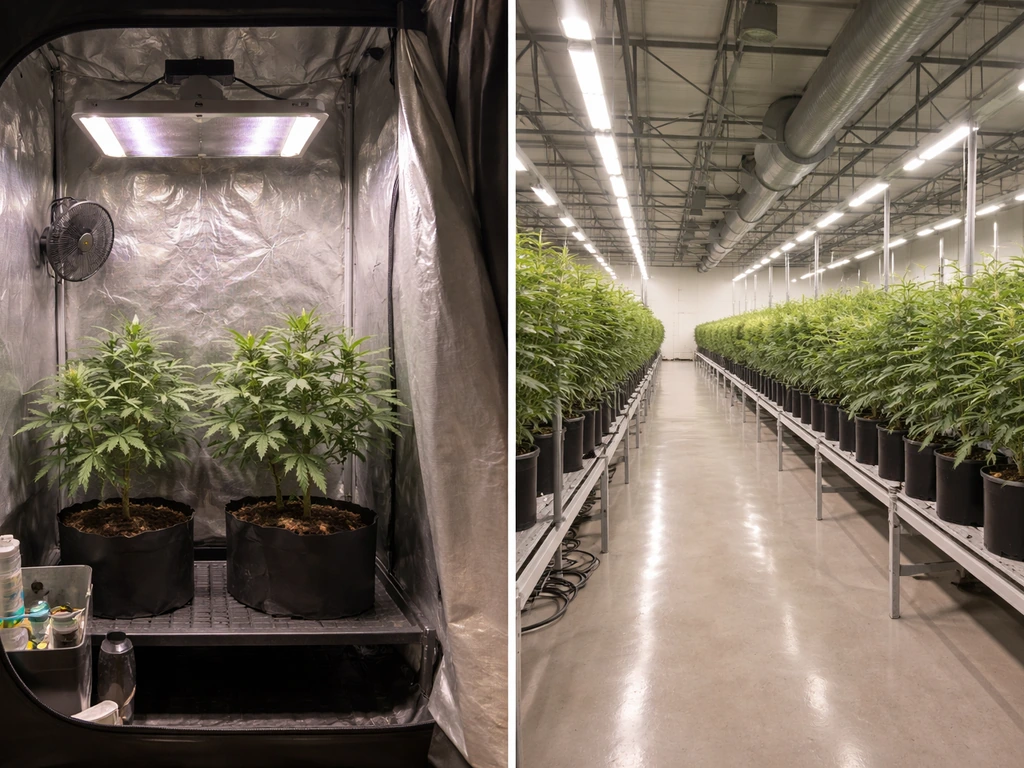
Home growers in Michigan don't need any license. If you're growing up to 12 plants at home for personal use, you're operating under the protections of MRTMA and no application is required. Just make sure your plants are in a locked, enclosed space not visible to the public.
Commercial growers choose from several license classes based on plant canopy size. Michigan uses a tiered system, and the Class A grow license Michigan is the entry-level option for smaller cultivators. Here's how the adult-use grower license classes break down:
| License Class | Canopy Size | Notes |
|---|---|---|
| Class A | Up to 100 plants | Smallest commercial tier; lowest fees |
| Class B | Up to 500 plants | Mid-tier for growing operations |
| Class C | Up to 2,000 plants | Larger commercial cultivation |
| Class C-EX (Excess) | Up to 10,000 plants | High-volume commercial grows |
| Nursery | Produces seeds/seedlings | Must hold another grower license too |
| Designated Consumption Establishment Grower | Varies | Tied to consumption establishment |
Most first-time applicants start with Class A or Class B depending on their intended scale. Larger operations pursuing Class C or above face higher fees, more intensive inspections, and greater capital requirements. If you're planning a serious commercial operation, exploring the Michigan commercial grow license requirements in detail before applying is worth the time.
Step-by-step process to apply for a grower license in Michigan
The adult-use commercial grow license process has two main stages: prequalification (Step 1) and the full establishment license application (Step 2). Here's how each works.
Step 1: Prequalification
Prequalification is where the CRA vets you and any other principals involved in the business before you're allowed to apply for the actual grow license. The CRA performs background checks on the main applicant and all supplemental applicants (meaning anyone with a significant ownership or control role). This step costs $3,000 and that fee is nonrefundable, so make sure you meet the basic eligibility requirements before submitting.
- Create an account in the CRA's online licensing portal (MiPlus)
- Complete the Step 1 prequalification application for each principal in the business
- Submit personal and financial disclosure documents for all applicants
- Pay the $3,000 nonrefundable prequalification fee
- Wait for the CRA to complete background checks and issue a prequalification determination
Step 2: Establishment license application

Once prequalified, you can submit your Step 2 application for the specific grow license class you want. This is where your facility details, security plan, and operational documentation come into play. The CRA is required by law to approve or deny a complete application within 90 days of receiving it along with the application fee, so a complete submission matters.
- Log back into MiPlus and start the Step 2 establishment application
- Select your desired grower license class (A, B, C, etc.)
- Upload proof of local approval (municipality zoning or authorization letter)
- Submit your facility diagram, security system plan, and operating procedures
- Provide proof of legal property control (lease, deed, or property agreement)
- Pay the Step 2 application fee for your license class
- Schedule and pass the CRA facility inspection before the license is issued
Requirements checklist: location, security, operations, and plant limits
Before you submit, make sure you've covered the following compliance areas. Missing even one of these is a common reason applications get delayed or denied.
Location and property
- Facility must be in a municipality that has opted in to allow cannabis businesses
- Property must comply with local zoning requirements for cannabis cultivation
- You must demonstrate legal control of the property (owned, leased, or licensed)
- The facility must be a permanent, enclosed structure (not a vehicle or temporary structure)
- Some municipalities require a local license or permit in addition to the state license
Security requirements
- A security alarm system covering all entry points and storage areas
- Video surveillance cameras covering all areas where cannabis is grown, stored, or transferred
- Video footage must be retained for a minimum of 30 days
- Restricted access areas clearly defined and controlled
- A security plan document submitted with your application
Operations and plant limits
- Plant counts must stay within your licensed class limit at all times
- All plants must be tracked in the state's cannabis tracking system (Metrc)
- You must have a compliant seed-to-sale tracking plan in place before approval
- A designated agent-in-charge must be identified for the facility
- All cannabis employees must be registered as cannabis employees with the CRA
Documentation to prepare

- Government-issued photo ID for all principals
- Personal financial disclosures and source-of-funds documentation
- Business formation documents (articles of incorporation, operating agreement, etc.)
- Floor plan or facility diagram drawn to scale
- Proof of local approval or zoning compliance letter
- Written security plan and operating procedures
Costs, timelines, and what ongoing compliance looks like
Here's what you're realistically looking at for costs. The Step 1 prequalification fee is $3,000 and nonrefundable. Step 2 application fees vary by license class, with smaller Class A licenses costing significantly less than Class C or higher. Plan for additional costs including local permit fees, facility build-out, security equipment, Metrc subscription, and legal or consulting fees for your application documents.
On timeline: once you submit a complete Step 2 application and fee, the CRA has 90 days to approve or deny it. In practice, the clock doesn't start until your application is truly complete, so incomplete submissions reset that window. Factor in additional time for the facility inspection, which happens before your license is issued.
Licenses are issued for one year from the date of original approval. That means renewal is an annual obligation. The CRA will notify you before expiration, but you're responsible for submitting your renewal application and fee on time. Operating on an expired license is a violation, so set a calendar reminder well before your annual renewal date.
Ongoing compliance after approval includes maintaining your Metrc tracking records accurately, keeping your security systems operational and footage retained for at least 30 days, reporting any changes to ownership or key personnel to the CRA, staying current on local licensing renewals, and undergoing CRA compliance inspections which can happen at any time.
Common mistakes, troubleshooting, and where to get official info
The biggest mistake applicants make is submitting before they have local approval locked down. The CRA won't issue a license without it, and waiting on a municipality while your application clock ticks is a frustrating situation. Get your local zoning letter or approval in hand before submitting Step 2.
Another common issue is incomplete financial disclosures. The CRA is thorough about source-of-funds documentation, especially for ownership stakes above certain thresholds. Vague or missing financial records are a top reason applications are returned as incomplete, which delays your 90-day review window.
People also underestimate how specific the facility diagram needs to be. A rough sketch won't cut it. The CRA expects a scaled floor plan that clearly identifies plant canopy areas, storage rooms, employee areas, entry points, and camera placement. Hiring someone familiar with cannabis facility diagrams is often worth the cost.
If your application gets denied, the CRA will provide a reason. You can request reconsideration or appeal through the administrative process, but it's far better to address issues proactively. If you're unsure whether your background or financial history could be a problem, that's worth sorting out before paying the nonrefundable $3,000 prequalification fee.
For official, up-to-date information, go directly to the Michigan Cannabis Regulatory Agency website at michigan.gov/cra. The CRA publishes all application forms, fee schedules, rules, and FAQs there. You can also contact the CRA directly by phone or email for application-specific questions. Don't rely on third-party summaries (including this one) for the current fee amounts or rule text since those can change. Always verify against the official source before you apply.
FAQ
If I qualify as a home grower, do I still need to register with the CRA or get any local approvals?
No state license is required for personal home growing when you are 21 or older and stay within the household plant limit. However, local rules can still affect where you can locate an indoor grow setup, so it is smart to confirm your municipality does not restrict residential cannabis cultivation arrangements even if it allows home growing.
Can I grow more than 12 plants at home if I spread them across multiple rooms or buildings?
Michigan’s personal-use limit is per household, not per room or per separate structure on the same property. If you exceed the allowed number, you risk falling outside the protections for home growing, which can trigger enforcement concerns.
What counts as an “enclosed, locked space” for home growing?
The expectation is that plants are not accessible to the public and cannot be easily reached from common areas. Practical steps include a door with a real lock, placement behind barriers, and ensuring the space is not visible from windows or areas where neighbors or passersby can view the plants.
If I want a small commercial grow, how do I choose between Class A and a higher class?
Your intended canopy size is the primary driver, but also consider the operational burden, inspection intensity, and capital you can sustain. Moving up a class often increases fees and compliance workload, so it can be cheaper long term to start at the class that matches your plan with minimal room for expansion, then apply for changes later through the proper process.
Can I start building my facility after prequalification but before Step 2 approval?
You generally should not treat prequalification as permission to operate. Building work can be affected by final approval conditions, so coordinate facility design, zoning, and security plans to match what you expect will be approved, and verify whether your local permits align with the eventual license conditions.
Does the 90-day CRA review clock begin immediately after I submit Step 2?
It starts only once the application is truly complete. Missing items, unclear documents, or incomplete supplemental materials can reset the timeline because the CRA may treat the submission as not complete until you cure deficiencies.
What happens if I cannot afford the $3,000 prequalification fee but I think I am eligible?
Prequalification is a required upfront cost for the commercial track you are describing, and the fee is nonrefundable. If you have any doubt about background eligibility, financial disclosure strength, or local feasibility, resolve that first before paying, so you do not waste the nonrefundable fee.
Are all “principals” required to be included in the background check for commercial licensing?
The CRA checks not only the main applicant but also supplemental applicants who have significant ownership or control roles. If you are structuring ownership, make sure you identify who qualifies as a principal early, because omissions can create delays and increase the chance your application is treated as incomplete.
What financial documents commonly cause applications to be marked incomplete?
Vague descriptions, missing source-of-funds detail, and records that do not clearly connect ownership money to the applicant or entity can lead to incompleteness. Keep clean documentation for how funds were earned, where they came from, and how they were transferred into the licensed business.
How specific does my facility diagram need to be for a commercial grow license?
Expect a scaled floor plan that identifies functional areas and operational flow, including plant canopy areas, storage, employee areas, entrances, and camera coverage locations. If you cannot clearly show camera placement and which areas are monitored, that is a frequent reason for back-and-forth during review.
Do I need Metrc access during the licensing process, or only after I receive the license?
Metrc obligations are an ongoing compliance requirement once licensed, but the application process often requires you to show you can operate under the tracking and reporting expectations. Plan for the Metrc subscription timeline and ensure your operations can immediately perform required recordkeeping when your license becomes active.
What counts as a “change” to report after I’m licensed?
Changes to ownership, key personnel, and other control roles are the critical categories. If you are unsure whether a particular role or transfer triggers reporting, err on the side of reporting or asking the CRA, because failure to report promptly can create compliance issues during inspections.
How should I handle license renewal to avoid accidentally operating on an expired license?
Renewal is annual, and operating on an expired license is a violation. Set reminders well before expiration, confirm the renewal fee and submission requirements in advance, and avoid waiting until the last days because you may need to gather updated documents for compliance.
If my commercial application is denied, can I still pursue reconsideration or appeal right away?
Yes, the CRA provides a stated reason for denial, and there is an administrative path to request reconsideration or pursue an appeal. The best approach is to address the stated deficiencies immediately and document your corrections, because you cannot rely on simply resubmitting without fixing the specific issues cited.
What should I do first if I’m unsure my background or financial history will be a problem?
Before paying the nonrefundable prequalification fee, run a self-check on the exact disqualifying categories you might fall into and gather your financial records so you can explain sources of funds clearly. If you are still uncertain, ask the CRA directly with your situation rather than assuming third-party summaries will be accurate for current rules.
Next Article
Grow License Michigan: Step-by-Step Application Guide
Step-by-step grow license Michigan guide: eligibility, fees, application portal, document checklist, limits, timing, ren