A craft grow license in Illinois is officially called a "Craft Grower" license, and it's a specific cannabis business establishment license category regulated by the Illinois Department of Agriculture (IDOA) under 410 ILCS 705 and 8 IAC Part 1300, Subpart D. If you've been searching for "craft grow license Illinois," this is the license you're looking for. It's not a home grow permit or a hobbyist registration. It's a commercial cannabis cultivation license with real canopy limits, significant fees, and ongoing compliance obligations. This guide walks you through everything from eligibility to what happens after you're licensed.
Craft Grow License Illinois: Step-by-Step Guide

Marcus Whitley
9 Apr 2026
What "craft grow license" actually means in Illinois

Illinois uses the term "Craft Grower" as an official license category under the Cannabis Regulation and Tax Act (CRTA). It sits alongside other cannabis business establishment types like cultivation centers, infusers, and dispensing organizations. The craft grower license is specifically designed for smaller-scale commercial cannabis cultivation, which distinguishes it from the larger cultivation center license. But "smaller scale" is relative. We're talking about regulated commercial operations with security plans, seed-to-sale tracking, and five-figure fees.
The IDOA's licensing pages use "Craft Grower" consistently, so if you're filling out forms or searching the IDOA portal, use that exact term. The rules governing everything a craft grower can and can't do live in 8 IAC Part 1300, Subpart D. That's your primary regulatory reference for operations, plant production, security, and recordkeeping. It's worth bookmarking. If you're just exploring whether growing at home without a commercial license is an option, that's a completely different topic covered under Illinois home grow rules, which has its own separate framework.
Eligibility rules and who can apply
Not everyone can apply, and getting disqualified late in the process is an expensive mistake. Here's what IDOA and 8 IAC Part 1300 require you to meet before you even submit an application.
Background checks and principal officers
All Principal Officers and agents associated with your craft grower application must pass criminal background checks. If principal officers change and background checks are required, IDOA’s guidance says you must submit a blank" rel="noopener noreferrer">fingerprint consent form to a participating in-state vendor. This is not optional and not something you can work around. Fingerprints must be collected within the last 30 days before submission, as specified in IDOA's instructions. blank" rel="noopener noreferrer">Step 3 of the IDOA application process specifically requires you to credential your organization's agents and Principal Officers through the IDOA online portal, uploading residency proof and fingerprint consent documentation. If any of your principals have disqualifying criminal history, the application will not move forward.
Ownership restrictions

Illinois places explicit ownership and control restrictions on craft grower applicants. Specifically, 8 IAC Part 1300 disallows certain ownership interests between craft grower licensees and cultivation center licensees. In practical terms, if you or your principals already have a controlling interest in a cultivation center license, that can disqualify you from holding a craft grower license, or vice versa. The rules are designed to prevent vertical consolidation that would undercut the craft tier's purpose. Review these restrictions carefully before structuring your ownership entity.
Location and spacing constraints
Your proposed facility location also has to meet spacing requirements. 8 IAC Part 1300 includes distance restrictions, meaning your craft grow operation cannot be located within a specified distance of another craft grower or cultivation center. This matters during site selection. Choosing a location before confirming it clears the spacing rules is one of the more common and expensive early mistakes applicants make.
Continuous eligibility requirement
IDOA is clear that eligibility under the CRTA statute and rules (410 ILCS 705 and 8 IAC Part 1300) must be maintained continuously, not just at the time of application. Changes to ownership, principal officers, or your facility after receiving a license can trigger compliance issues if they push you outside eligibility requirements. Keep this in mind as your business evolves.
License types, cultivation limits, and canopy rules
The craft grower license has a hard canopy cap. Under Illinois Register rule text referencing 8 IAC Part 1300, a licensed craft grower's canopy space cannot exceed 14,000 square feet at any time. This is the ceiling. Your actual starting canopy may be smaller depending on your application commitments, but you cannot go above 14,000 square feet regardless of demand or expansion plans.
Canopy space in Illinois refers to the area where cannabis plants are actually cultivated, and the rules around plant production require that your production areas allow unobstructed travel, observation, and inventory of each plant group. This is both an operational requirement and an inspection checkpoint. If your grow room layout makes it difficult for an inspector to physically walk through and observe individual plant groups, you have a compliance problem.
The craft grower license is one specific commercial tier. It's different from a cultivation center license, which operates at larger scale without the 14,000 square foot canopy cap that applies here. If you're curious how Illinois's approach compares to other states' cultivation frameworks (for example, Ohio Issue 2 home grow introduced its own cultivation rules), the state-by-state differences are significant.
How the application process works, step by step

IDOA lays out the craft grower application process as five distinct steps. Applications are submitted during open application periods, so timing matters. You cannot just apply whenever you want. Watch IDOA's website for open windows.
- Step 1: Apply through IDOA's online licensing and registration portal during an open application period. This is where you submit the cannabis business license application and pay your application fee.
- Step 2: Obtain and maintain an active license. If your application is awarded, IDOA will communicate a time window for you to satisfy the remaining requirements and pay the license award fee.
- Step 3: Credential your organization's agents and Principal Officers through the IDOA portal. You'll upload residency proof and fingerprint consent documentation (fingerprints collected within the last 30 days).
- Step 4: Obtain access to Illinois's seed-to-sale traceability program. You'll need to register with Metrc, the state's track-and-trace system, and order RFID tags for tagging all plants and packages.
- Step 5: Complete any remaining license and credentialing steps required by the Department as communicated after your award.
For a deeper look at what goes into each of these steps before you sit down at the portal, the Illinois cannabis grow license application guide covers document preparation and submission details in more depth.
One thing applicants frequently underestimate: the time between application submission and the point where you're actually licensed and operational can be significant. The post-award steps (security plan approval, facility readiness, Metrc setup) all take time, and IDOA gives you a defined window to complete them after an award. If you're not ready, you can fall behind. There is an operational extension process under 8 IAC 1300.310(E), and IDOA provides a craft grower operational extension application form for this purpose. However, it must be submitted before the blanket extension due date IDOA specifies. Don't wait until the last minute.
Costs, fees, and financial documents you'll need
The fees for a craft grower license are substantial, and all of them are nonrefundable. Here's what IDOA's fee schedule shows:
| Fee Type | Amount | Notes |
|---|---|---|
| Application for License | $25,000 | Nonrefundable; paid at time of application |
| License Awarded Fee | $40,000 | Nonrefundable; paid after award, within IDOA's window |
| License Renewal Fee | $40,000 | Nonrefundable; quarterly installments available for certain renewal rounds |
| Modification Application Fee | $2,500 | For changes to licensed operations |
| Agent ID Card Application/Renewal | Varies | Per agent; check current IDOA fee chart |
IDOA has allowed craft grower renewal fees to be paid in quarterly installments for certain renewal cycles, with $10,000 payments at set due dates. This has been extended for specific renewal rounds, so check the IDOA news page for the most current installment schedule before planning your cash flow.
Beyond the direct fees, expect that your application will need to demonstrate financial capacity. The application process and IDOA rules anticipate that craft growers are real businesses with real facilities, so financial documentation showing you can actually build out and operate your grow is part of what the application requires. Having your financial records, entity formation documents, lease or property agreements, and proof of capitalization organized before you start will save you significant stress.
Staying compliant after you're approved
Getting licensed is the beginning, not the finish line. Illinois has detailed post-approval compliance requirements for craft growers, and noncompliance can put your license at risk.
Security plans and Illinois State Police
The Illinois State Police Cannabis Control Office (CCO) handles security plan reviews for IDOA-licensed cannabis entities, including craft growers. You need to prepare and submit a security plan that meets ISP/CCO requirements. The CCO provides guidance on how to properly submit these plans. Your plan needs to cover physical security, access controls, surveillance systems, and other elements that regulators will review before your facility is cleared to operate.
Seed-to-sale tracking with Metrc
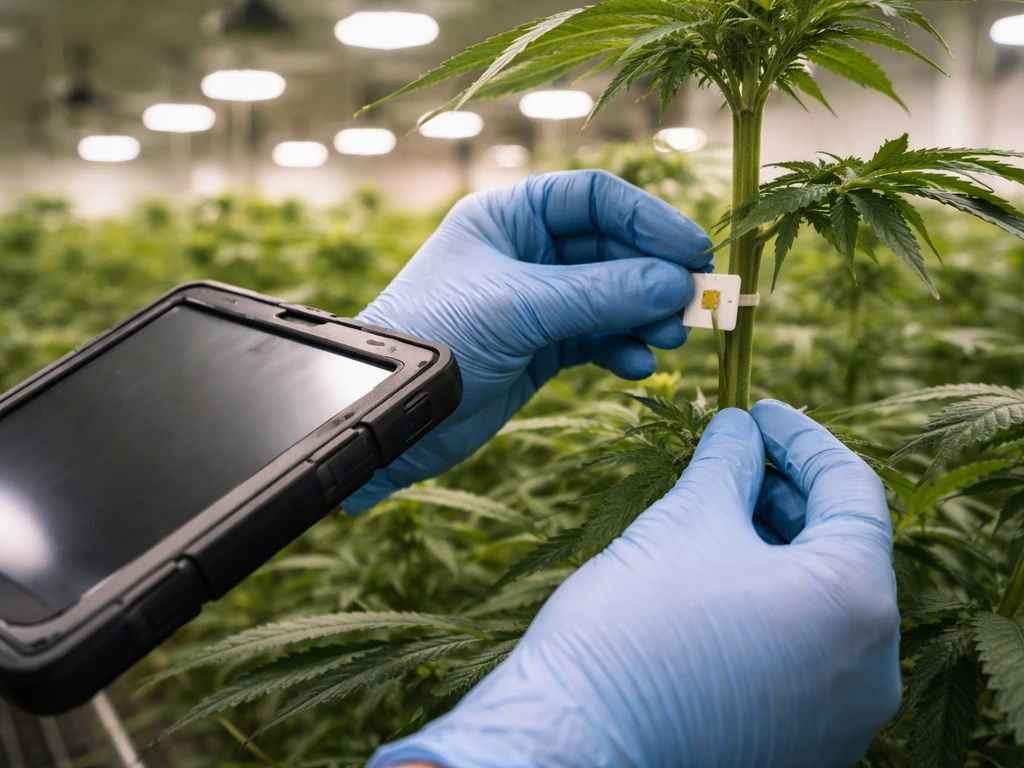
Illinois uses Metrc as its mandatory seed-to-sale tracking system. As a craft grower, you're required to tag all cannabis plants and packages with RFID tags and enter them into Metrc. Illinois will directly pay Metrc for RFID tags within reasonable limits, but you can also purchase additional tags at your own expense. The rollout is phased: cultivation centers and craft growers add plants and products before dispensaries transition for sales tracking. If you start operations with no cannabis on hand, the ISP Craft Grower Checklist specifies that you must record this as your "initial inventory" in the system. That sounds minor, but skipping it creates a recordkeeping gap that shows up in audits.
Inspections and what they look for
The ISP Cannabis Control Office publishes a Craft Grower Checklist referencing 8 IAC Part 1300. This checklist covers inventory management and security plan compliance checkpoints. Inspectors will be looking at whether your production areas allow unobstructed access to each plant group, whether your Metrc records match your physical inventory, whether your security systems are functioning as specified in your approved plan, and whether your recordkeeping is current and complete. Running through that checklist yourself before any scheduled or surprise inspection is good practice.
Ongoing reporting obligations
Craft growers have ongoing reporting requirements to IDOA. All plant movements, harvests, transfers, and waste disposals need to be tracked and reported through Metrc. Keeping your Metrc records accurate and timely is not optional. Discrepancies between your physical plants and your Metrc records are a compliance issue, and they are exactly the kind of thing inspectors check.
Renewals, transfers, and mistakes to avoid
Renewing your license
Renewal fees are $40,000 (nonrefundable), with quarterly installment options available for certain rounds. Watch IDOA communications carefully for renewal windows and installment due dates. Missing a renewal deadline or payment installment can jeopardize your license. Renewals also require that you continue to meet all eligibility requirements under 410 ILCS 705 and 8 IAC Part 1300, so any ownership or principal officer changes that have occurred during your license period need to have been properly disclosed and approved.
Transferring your license
Illinois rule text allows a craft grower license to be transferred without charge to an heir of a deceased licensee, but the heir is still subject to a full criminal background check and other requirements under the rules. For non-inheritance transfers or ownership changes, the modification application fee is $2,500, and the process is governed by 8 IAC Part 1300. Ownership transfers are not informal. They require IDOA approval, and operating under unapproved ownership changes is a compliance violation.
Common mistakes applicants make
- Choosing a facility location before confirming it clears IDOA's spacing requirements from other craft growers and cultivation centers.
- Submitting fingerprints that were collected more than 30 days before the application, which IDOA will reject.
- Underestimating the time needed to complete post-award steps (security plan approval, Metrc setup, facility readiness) and missing IDOA's window.
- Failing to submit an operational extension application before the blanket extension due date when delays occur.
- Not recording initial inventory in Metrc when starting operations with zero cannabis on hand.
- Structuring ownership without reviewing the craft grower/cultivation center ownership restriction rules first.
- Treating the $25,000 application fee as a recoverable cost if the application is denied. It is not refundable.
- Missing quarterly installment due dates for renewal fees due to poor cash flow planning.
- Making operational modifications (facility changes, new equipment areas) without filing a modification application and paying the $2,500 fee.
- Assuming eligibility is a one-time check rather than a continuous requirement throughout the license period.
The craft grower license pathway in Illinois is real and achievable, but it demands serious preparation, significant capital, and sustained attention to compliance. The regulatory framework under 8 IAC Part 1300 is detailed and enforceable. The best thing you can do is treat this as the regulated commercial operation it is from day one, not as something you'll figure out after you get the license.
FAQ
If I’m applying as a small cannabis grower, can I submit under a different license type and still operate like a craft grower?
No. The application is tied to the exact “Craft Grower” license category and the IDOA will expect you to follow the Craft Grower ruleset and capacity constraints for that tier, not a generic cultivation concept.
What happens if a principal officer’s fingerprints are collected too early or too late before I submit the craft grower application?
Yes, and the key risk is late stage disqualification if a principal or agent’s background check does not clear or if the fingerprint collection timing is outside the window IDOA specifies for that application submission.
Can my craft grower and my cultivation center be owned by the same group of investors?
It can. If you have controlling interests in a cultivation center, cross-tier ownership restrictions may block approval, even if you intend to keep operations separate. You typically need to structure ownership so the disallowed relationships do not exist at the time of review.
If my facility is leased and the neighborhood has existing cannabis licenses nearby, how can I avoid failing Illinois spacing rules?
You should treat spacing as a front-end gate, not a later fix. If your proposed site fails spacing distance requirements, you may have to redo site selection and that can delay your post-award readiness timeline.
How do I design my grow rooms so they pass inspection for unobstructed access and plant group observation?
Start by mapping your production flow so an inspector can physically move through without obstruction and observe each plant group. Layout issues that “work” operationally can still fail inspection if they prevent unobstructed access or create hard-to-audit plant group boundaries.
If I change owners or key personnel after I’m licensed, am I automatically still compliant?
Maintain eligibility as a live requirement. Ownership changes, principal officer changes, or facility changes during the license period can require disclosures or approvals, and operating after a change that effectively removes you from eligibility can trigger enforcement.
If I’m planning a staged expansion, can I temporarily exceed the 14,000 square foot craft canopy limit while I ramp up?
The canopy cap is a hard ceiling at 14,000 square feet at any time. Expansion planning should assume you cannot “temporarily overshoot” even if you think you will reduce canopy later, because the rule is tied to any time during operations.
When I start with no plants on site, what Metrc records should I set up first to avoid inventory gaps?
Be explicit in Metrc for your first period of operations. If you have zero product at launch, you still need to record the initial inventory state properly, otherwise you risk mismatches during audits and inventory reconciliation.
What are common reasons craft growers get delayed during security plan review, beyond submitting the plan late?
Not just “send plans,” but ensure the security plan matches what you will build and how staff will use it. Regulators review physical security systems and operational controls, and discrepancies between the approved plan and what’s installed can delay clearance.
How do I reduce the risk of Metrc recordkeeping errors by staff after licensing?
Often, yes. Metrc requires timely, accurate tracking of movements, harvests, transfers, and waste, and staff-driven data errors can create real compliance problems, including inconsistencies between physical count and RFID-recorded inventory.
If I want to pay renewal fees in installments, where do I confirm the exact installment due dates for my renewal round?
Yes. For certain renewal rounds, Illinois has offered quarterly installment options with set due dates. The practical takeaway is to check the most current installment schedule from IDOA communications before you rely on installments for cash flow.
If I’m behind on readiness steps after award, when should I file an operational extension request so it still counts?
It depends on timing and the extension type. There is an operational extension process, but it must be submitted before IDOA’s blanket extension due date you are warned about, so waiting can forfeit your ability to use the operational extension route.
If I want to add an investor or shift ownership percentages mid-license, do I just update my business documents and notify IDOA later?
No, not informally. For non-inheritance transfers or ownership changes, you generally need an IDOA modification application and approval process, and operating without approval can be treated as a compliance violation.
If a craft grower license goes to an heir, does the heir automatically qualify without another review?
For an inheritance transfer, the heir still must pass the required background checks and meet ongoing requirements. The transfer is not a free pass around eligibility, it is a specific allowance, with conditions still applied.
Next Article
Ohio Issue 2 Home Grow Update: Legal Limits and Steps
Ohio Issue 2 home grow update: legal limits, eligibility, plant counting, compliance steps, and when a license is requir